
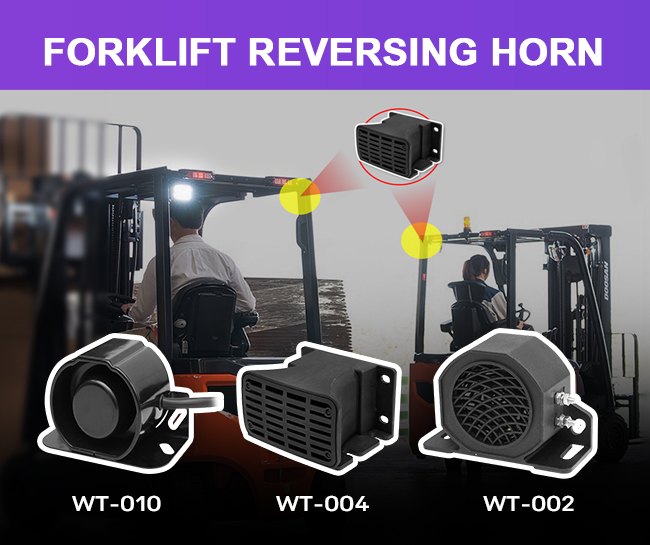
In the dynamic and often hazardous environment of warehouses, construction sites, and manufacturing plants, safety is paramount. Among the symphony of industrial sounds—the hum of motors, the clatter of pallets, the beep of scanners—one distinct signal stands out as a critical guardian: the forklift reversing horn.
More than just a simple beep, the forklift reversing horn, or backup alarm, is a fundamental engineering control designed to prevent one of the most common and dangerous incidents in material handling: pedestrian strikes. When a forklift operator engages reverse gear, this device automatically activates, emitting a loud, unmistakable warning. Its primary function is to alert nearby workers, who may be in blind spots or focused on their own tasks, that a multi-ton vehicle is moving towards them.
There are two main types of reversing alarms:
Standard Tonal Horns: These produce a consistent, repetitive beep. While effective, their constant noise in busy environments can contribute to "alarm fatigue," where workers become desensitized to the sound.
Broadband/White Sound Horns: A more modern solution, these emit a "ssh-ssh" sound that is distinctly localized. This allows pedestrians to instantly identify not only that a vehicle is reversing, but also the precise direction of the sound source. This technology reduces overall noise pollution and combats alarm fatigue, making the warning more effective.
The importance of this device cannot be overstated. Forklifts have significant rear blind spots, and even with mirrors and cameras, operator visibility is limited. The horn serves as an essential auditory extension of the operator's awareness. It is a proactive tool that fulfills the "see and be seen" (or in this case, "hear and be heard") principle of workplace safety. Regulatory bodies like OSHA (Occupational Safety and Health Administration) strongly mandate the use of such warnings on powered industrial trucks where the operator's view is obstructed.
However, the effectiveness of a reversing horn depends on several factors. It must be properly maintained—a faulty or muted horn is a serious safety violation. The work environment itself must be considered; excessively noisy areas may require additional visual warnings like flashing lights. Crucially, the horn is a warning device, not a safety guarantee. It does not replace the need for safe operating procedures, designated pedestrian pathways, operator training, and constant vigilance.
In conclusion, the forklift reversing horn is a deceptively simple piece of safety equipment that plays an outsized role in protecting lives. It is the voice of the machine, calling out its movements in a potentially chaotic space. By cutting through visual obstructions and demanding attention, this unassuming horn helps create the auditory landscape necessary for forklifts and people to coexist safely, making it a true unsung guardian of the industrial workplace.



Phone : +86 -13924120087
Email : info@wetechhk.com
Address : UNIT NO.532B ON 5/F, STAR HOUSE, NO.3 SALISBURY ROAD, KOWLOON,HONGKONG
Factory Address: Dongguan, Guangdong Province, China
Copyright @ 2026 Wetech Electronic Technology Limited All Rights Reserved.  Network Supported
leave a message
Scan to Wechat :

Scan to WhatsApp :