
In an environment where hazards can emerge at any moment, visibility is not just a convenience—it is a critical component of safety. Whether on a busy highway, a chaotic construction site, or a remote trail, the ability to signal one's presence can mean the difference between a close call and a catastrophe. At the heart of modern safety technology lies the rechargeable beacon signal warning light: a compact, powerful, and versatile device designed to alert, warn, and protect.
The Evolution of the Warning Beacon
Traditionally, warning beacons were bulky, power-hungry devices tethered to vehicle cigarette lighters or disposable battery systems. They served their purpose but came with significant limitations: limited runtime, high operational costs, and a lack of portability.
The advent of LED (Light Emitting Diode) technology, combined with advanced lithium-ion battery systems, has revolutionized this space. The modern rechargeable beacon signal warning light is a triumph of engineering, offering intense illumination while remaining cordless and sustainable . These devices are no longer just "lights"; they are intelligent safety systems designed for maximum adaptability.
Key Technological Features
Today’s market offers a diverse range of warning beacons, but the most effective models share a core set of technological advancements.
1. High-Intensity LED Arrays and Visibility
The primary function of a beacon is to be seen. Modern units utilize multiple LEDs to achieve Class 3 visibility, meaning they can be detected from up to 800 meters away or more . Some high-performance models boast visibility ranges extending to nearly a mile at night, ensuring that oncoming traffic or rescue aircraft can pinpoint a location with ease . Unlike old rotating bulbs, LED arrays can create 360-degree illumination patterns without moving parts, reducing mechanical failure .
2. Multi-Color Capabilities and Flash Patterns
Versatility is key. A single device now often supports a spectrum of colors—amber for construction, red/blue for emergency response, green for security, and even white for general illumination . Advanced models go a step further by offering multiple flash patterns. Users can switch between rotating effects, single strobes, quad-flash, alternating blinks, and even SOS distress signals depending on the regulatory requirement or scenario .
3. Durability and Environmental Resistance
A warning light is useless if it fails in harsh weather. High-quality rechargeable beacons are built to withstand extreme conditions. Constructed from reinforced composites or polycarbonate, they are often shatterproof, crushproof, and corrosion-proof . Many boast IP (Ingress Protection) ratings of IP68, meaning they are not only dust-tight but can survive submersion in water—sometimes to depths of up to 80 meters or more . This durability extends to temperature resilience as well, with military-spec models operating reliably in ranges from -40°C to over 100°C .
4. Cordless Freedom and Versatile Mounting
The "rechargeable" aspect eliminates the "umbilical cord" of the past. Powered by long-life Li-ion batteries, these units can operate for anywhere from 8 hours on high-intensity strobe to over 60 hours in single-blink economy modes . When power runs low, USB-C connectivity allows for convenient charging from wall adapters, vehicles, or portable power banks .
To complement their cordless nature, these beacons feature incredibly versatile mounting options. Heavy-duty magnetic bases allow for instant attachment to car roofs, truck doors, or machinery without tools . For tactical or outdoor use, hook-and-loop fasteners, MOLLE-compatible clips, and helmet mounts ensure the light goes where the user goes .
Applications Across Industries
The adaptability of the rechargeable beacon signal warning light has made it indispensable across a wide spectrum of fields.
Roadside and Traffic Safety: From broken-down passenger vehicles to slow-moving construction trucks, these lights provide the immediate visibility required to prevent secondary accidents. They are essential for police, tow truck drivers, and highways maintenance crews .
Emergency Services: Police, fire, and rescue personnel utilize multi-color beacons for scene management. The ability to quickly deploy a magnetic light to mark a hazard or a landing zone is invaluable. The lack of cords means first responders can move freely without tripping hazards .
Construction and Industrial Sites: In noisy or dusty environments, visual signals are often more effective than audible ones. These lights mark hazardous machinery, excavation pits, and restricted areas, ensuring worker safety .
Outdoor Recreation and Tactical Use: For cyclists, hikers, and runners, these compact lights offer a lifeline. In tactical scenarios, they are used for team identification, covert marking (using IR modes), and perimeter signaling . Their ability to float also makes them ideal for marine safety .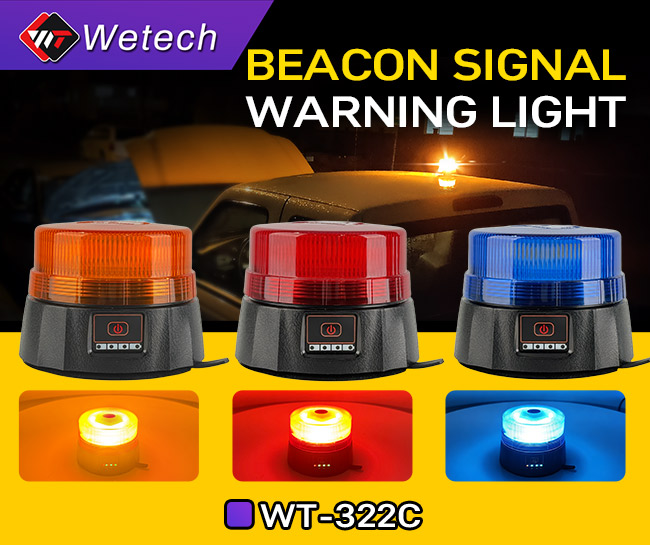



Phone : +86 -13924120087
Email : info@wetechhk.com
Address : UNIT NO.532B ON 5/F, STAR HOUSE, NO.3 SALISBURY ROAD, KOWLOON,HONGKONG
Factory Address: Dongguan, Guangdong Province, China
Copyright @ 2026 Wetech Electronic Technology Limited All Rights Reserved.  Network Supported
leave a message
Scan to Wechat :

Scan to WhatsApp :