
Forklift operations are the backbone of most warehouses and industrial facilities—but they also come with significant safety risks, most notably sudden collisions with pedestrians and other vehicles, often caused by blind spots. In busy industrial settings, a forklift’s inherent design and tight operating spaces constantly limit an operator’s line of sight, making blind spots an unavoidable, ever-present hazard. The U.S. Occupational Safety and Health Administration (OSHA) explicitly notes in its Forklift Safety Guidelines that “blind spots and failed warning devices are among the leading causes of forklift collision incidents,” events that all too often result in worker injuries, costly equipment damage, and unplanned operational downtime. This is precisely why forklift safety warning lights are not an optional add-on—they are a critical safety component that directly cuts down on preventable incidents. In this post, we’ll break down exactly how these lights minimize blind spots, stop collisions before they happen, and help you build a safer, more reliable workplace.
1. Understanding Forklift Blind Spots and Collision Risks
Before we dive into how warning lights solve these safety issues, let’s cover the fundamentals: what forklift blind spots are and the collision risks they create every day on your warehouse floor. A forklift’s blind spots are the areas an operator cannot see directly, either through their line of sight or via the vehicle’s mirrors. While exact blind spots vary slightly by forklift model, they share consistent, high-risk characteristics across nearly all standard equipment.
1.1 What Are the Primary Forklift Blind Spots?
There are three core blind spot zones that every operator and on-site worker needs to watch for. First, the front blind spot: this sits directly ahead of the forks and is especially problematic when the mast is raised or the truck is carrying a load, which completely blocks the operator’s view of the area right in front of the vehicle. Second, the rear blind spot: this is the largest and most dangerous blind spot for nearly all forklifts. Since the operator’s seat faces forward, they have almost no direct visibility of pedestrians or equipment approaching from behind. Third, side blind spots: these are created by the forklift’s body, mast, and forks, which obscure the areas along both sides of the vehicle—an even bigger risk when navigating narrow warehouse aisles or tight spaces between pallet racks.
1.2 Common Collision Scenarios Caused by Blind Spots
These blind spots are the root of countless avoidable incidents. For example, a pedestrian walking behind a reversing forklift may be completely unseen by the operator, leading to a devastating collision. When two forklifts pass each other in a narrow aisle, side blind spots can easily cause side-swipe impacts. Even the front blind spot can lead an operator to crash into pallet racks, stacked inventory, or fixed facility equipment, resulting in costly damage to both goods and infrastructure.
1.3 The Hidden Danger of Operating Without Warning Lights
Blind spots on their own are a major risk—but pair them with a lack of clear, visible warning signals, and the likelihood of an accident skyrockets. Without dedicated warning lights, pedestrians and other equipment operators may not realize a forklift is nearby until it’s too late, especially in dimly lit warehouses or during overnight shifts. This lack of advance warning leaves no time for evasive action, turning a manageable blind spot challenge into a serious, life-altering safety incident.
2. How Forklift Safety Warning Lights Minimize Blind Spots
Forklift safety warning lights operate on a simple but highly effective visual alert principle: they use bright, highly visible lighting to extend the forklift’s “visible footprint,” making the vehicle known to pedestrians and other operators even when it’s hidden in a blind spot. Every feature of these lights is intentionally designed to target the core blind spot zones we outlined above.
2.1 The Core Visual Alert Principle
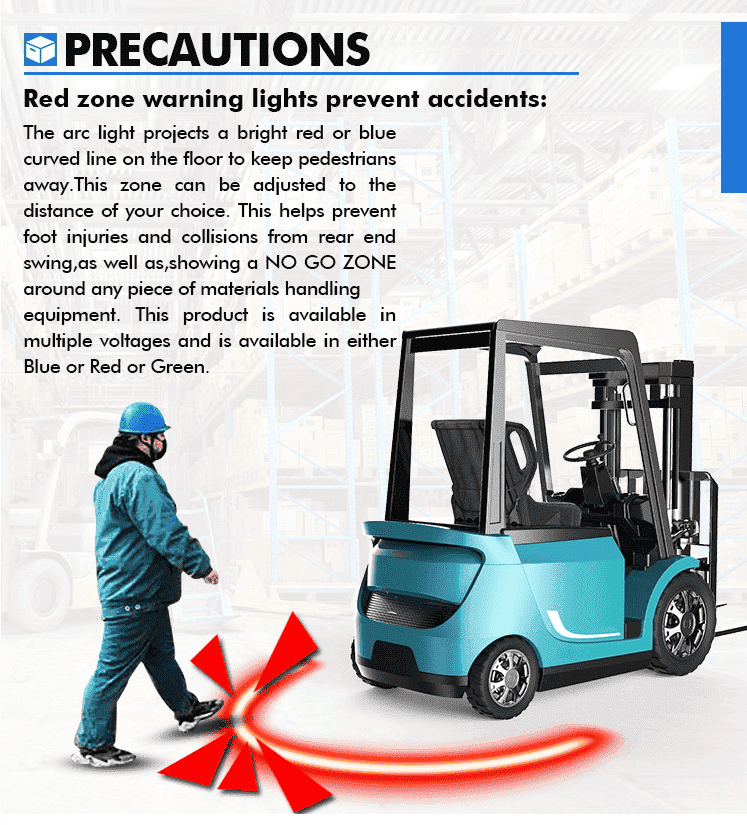
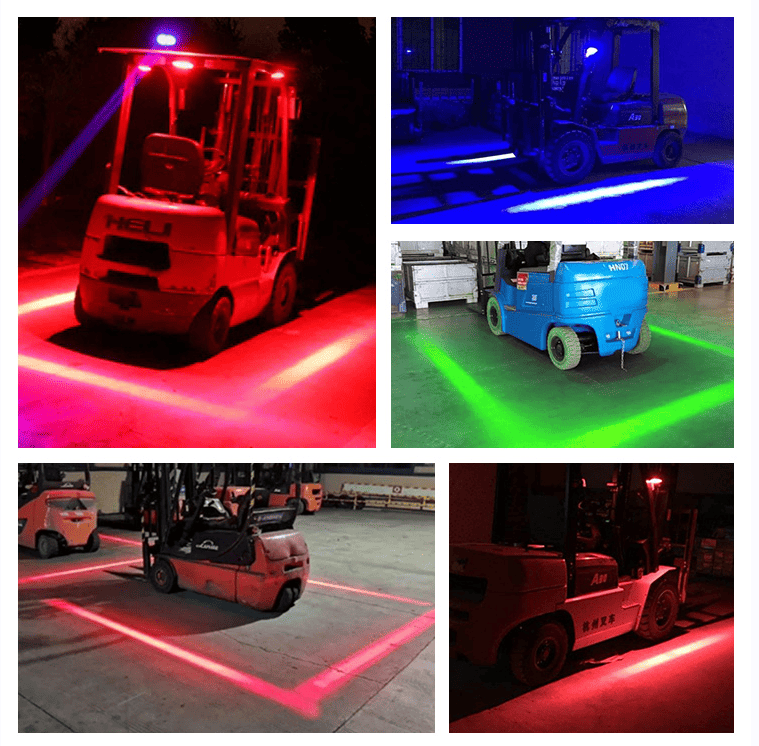
Nearly all modern forklift safety warning lights use high-intensity LEDs, available in green, red, blue, or custom color combinations to suit your facility’s needs. Our Forklift Safety Warning Lights also offer customizable beam patterns, including line beam, arc beam, spot beam, and arrow/spot beam, with settings for flashing, steady burn, or linear projection. These lights are engineered to be highly visible even in bright daylight or dark, low-light warehouse environments, ensuring anyone in the vicinity can quickly recognize that a forklift is operating nearby.
2.2 Targeted Functions for High-Risk Blind Spots
Warning lights mounted to the rear of the forklift emit bright, flashing illumination that directly addresses the vehicle’s largest blind spot. They alert pedestrians, other forklifts, and vehicles approaching from behind that a forklift is in operation—even when the operator cannot see them. Side warning lights or red line projection lights, mounted along the forklift’s sides, project a bright red line on the floor around the vehicle. This line acts as a clear “warning boundary” for the forklift’s operating range, stopping pedestrians from accidentally stepping into the side blind spots. High-intensity warning lights, typically mounted to the top or front of the forklift, boost visibility in dim warehouses, night operations, or low-light areas, reducing the impact of front and rear blind spots by making the forklift easily detectable from a distance.
3. How Forklift Safety Warning Lights Prevent Collisions
While minimizing blind spots is their core function, forklift safety warning lights also directly prevent collisions through three key mechanisms: advance warning, clear operating status signaling, and reduced human error.
3.1 Advance Warning Capability
The most fundamental function of warning lights is to provide early, proactive alerting. Flashing or steady-burn lights make a forklift visible from a much greater distance, giving pedestrians and other operators time to notice its presence before it enters their line of sight—even when it’s hidden in a blind spot. For example, a pedestrian walking around a stack of pallets can see the flashing warning light of an approaching forklift long before the vehicle comes into view, giving them plenty of time to move to a safe area.
3.2 Clear Operating Status Signaling
Many advanced warning light systems, including our Forklift taillight/wireless trailer lighting kits, use distinct color-coding and modes to signal a forklift’s movement and intended direction. For example, white lights activate when the forklift is reversing, red lights stay steady during forward travel, and yellow lights function as turn signals (note: exact color and mode configurations vary by manufacturer; always confirm with your supplier for details). This helps on-site personnel quickly judge the forklift’s next move, reducing the misjudgments that so often lead to collisions. If a pedestrian sees a white reversing light activate, for instance, they know to immediately avoid the forklift’s rear blind spot zone.
3.3 Reduced Human Error
Even the most experienced, well-trained forklift operators can make mistakes or miss hazards hidden in blind spots. Warning lights act as a critical supplementary safety layer, reducing the sole reliance on the operator’s visual observation. They serve as a constant, unmissable reminder to both the operator and everyone around the vehicle to stay alert, cutting down on collisions caused by momentary inattention, distraction, or a failure to notice a hazard in a blind spot.
4. Key Tips for Choosing Effective Forklift Safety Warning Lights
To ensure your warning lights reliably reduce blind spots and collision risks, it’s critical to select the right products for your facility’s unique environment and operational needs. Here are three non-negotiable factors to consider:
4.1 Brightness and Visibility
Warning lights must be bright enough to be clearly seen in your specific working environment. For outdoor or well-lit indoor warehouses, choose high-lumen output lights that maintain visibility even in direct daylight. For dimly lit facilities or overnight operations, we recommend floodlights that maintain excellent visibility without producing harsh, distracting glare that could impair the operator or other on-site personnel.
4.2 Warning Mode Selection
Match your warning mode to your operational scenario. Flashing lights are more attention-grabbing, making them ideal for busy, high-traffic warehouses with constant pedestrian and equipment movement. Steady-burn lights work well for lower-traffic areas, providing consistent, non-intrusive awareness of the forklift’s presence. Red line projection lights are strongly recommended for narrow aisles or areas with frequent pedestrian foot traffic, as they create a clear, unmissable boundary for the forklift’s operating range.
4.3 Durability for Industrial Environments
Industrial settings are harsh on equipment, so your warning lights must be built to withstand long-term, heavy use. Always select lights with an IP67 rating or higher for waterproof and dustproof performance, ensuring they hold up to dust, water splashes, and tough day-to-day conditions. Additionally, shock resistance and high-temperature tolerance are non-negotiable: forklifts produce constant vibration during operation and may be used in unconditioned, high-temperature warehouses or outdoor yards.
Conclusion
Forklift safety warning lights are far more than just a box to check for regulatory compliance—they are a cost-effective, practical solution to the two core safety hazards of forklift operations: blind spots and collisions. By extending the forklift’s visible footprint, providing advance warning to everyone on-site, and marking clear safe operating boundaries, these lights directly protect the safety of operators, pedestrians, and your equipment while reducing costly accident-related losses and unplanned downtime.
For any facility that relies on forklifts, outfitting your fleet with high-quality, fit-for-purpose safety warning lights is an essential step in building a safer work environment. Choosing the right lights for your needs doesn’t just boost safety—it also improves operational efficiency and gives your entire team peace of mind on the job. If you’re still unsure which lighting setup is right for your forklift fleet, our team is here to help. Reach out anytime, and we’ll craft a custom safety solution tailored to your operation’s unique needs.



Phone : +86 -13924120087
Email : info@wetechhk.com
Address : UNIT NO.532B ON 5/F, STAR HOUSE, NO.3 SALISBURY ROAD, KOWLOON,HONGKONG
Copyright @ 2026 Wetech Electronic Technology Limited All Rights Reserved.  Network Supported
leave a message
Scan to Wechat :

Scan to WhatsApp :