
Many warehouses and industrial facilities run night shifts to maintain smooth operations, but forklift operators working after dark face significantly higher safety risks. Research from the National Safety Council (NSC) and the journal Occupational Medicine shows that workplace accidents occur far more often during night shifts than during the day, with the highest risk in the early morning hours when the body’s circadian rhythm is at its lowest point.
This increased risk is tied to two critical factors: operator fatigue and poor lighting. The Occupational Safety and Health Administration (OSHA) emphasizes that insufficient lighting is one of the leading contributing factors in forklift accidents—a problem that becomes even more severe in low-light, overnight environments.
High-quality forklift lighting is not just a convenience. It plays a vital role in improving operator alertness, reducing vision-related risks, and supporting safer overall operations. In this article, we explain why reliable forklift lighting matters for night shifts, and how the right lighting can support your team and lower avoidable risks.
1. Unique Safety Challenges for Night-Shift Forklift Operators
Forklift operators on night shifts face more visual challenges than those working during the day, and these challenges can increase accident risk if unaddressed. Warehouse lighting is often dimmer at night, and even well-lit facilities have shadowed areas—between racks, near loading docks, and in tight corners—that expand blind spots. Unlike daytime operations, there is no natural light to compensate for weak artificial lighting, which increases both fatigue and the chance of errors.
Working in low-light conditions places extra strain on operators. Research from the Canadian Centre for Occupational Health and Safety (CCOHS) and the International Labour Organization (ILO) shows that poor lighting can slow reaction times. In a fast-paced warehouse environment, even a small delay can greatly increase the chance of an incident. For example, an operator traveling at a moderate speed may not have enough time to react to an unexpected obstacle if visibility is poor.
Long periods of work in dim conditions also lead to eye strain, which is closely linked to more mistakes on night shifts. When operators must strain to see their surroundings, focus and awareness decrease over long shifts—all of which raise safety risks in low-light areas. A common example is a night-shift operator, tired from long hours and squinting in dim light, misjudging the distance to a pallet rack. This is not carelessness; it is the result of poor lighting worsening the natural challenges of night work, and better lighting can help reduce this risk.
2. How Proper Forklift Lighting Supports Night-Shift Safety
High-quality forklift lighting does more than simply improve visibility—it creates a safer working environment that helps operators handle the unique challenges of night shifts. Well-made forklift lights deliver bright, consistent illumination that matches the natural sensitivity of the human eye, helping to reduce eye strain and delay the onset of visual fatigue.
Stable, even lighting is especially important for night work. Flickering, uneven, or overly dim lighting forces the operator’s vision to adjust constantly, leading to much greater physical and mental exhaustion over long shifts. Smooth, predictable lighting helps operators maintain steady focus and keeps their visual system more relaxed throughout the shift. This stability supports better concentration: when operators do not have to struggle with inconsistent brightness, they stay more alert, which helps lower mistakes such as misjudging distances or missing small hazards on the floor.
Proper wide-angle lighting expands the operator’s field of vision, reduces blind spots caused by shadowed areas, and further improves safety during night shifts. Standard lights typically illuminate only a narrow path directly ahead, leaving the left and right sides in darkness. Wide-angle beams cover a much broader area, reduce shadows around the forklift, and improve visibility to both sides. This wider coverage allows operators to notice approaching pedestrians, obstacles, or changes in aisle conditions earlier, supporting smoother, more controlled operation and helping lower the risk of collisions with people or other equipment. Our 54W Wide Angle LED Headlight Work Light is suitable for tractors and trucks, and we also offer customized versions built to match forklift voltage requirements, designed to meet the real-world needs of different customers.
3. Key Features to Choose for Night-Shift Forklift Lighting
To maximize safety during night shifts, it is essential to select forklift lighting engineered specifically for low-light operating conditions. Below are three core features to prioritize:
3.1 Brightness and Stability
Choose high-lumen LED lights that provide steady, consistent output. Flickering or uneven lighting increases eye strain and distracts operators, so look for models that maintain stable brightness during long hours of use. This level of brightness improves visibility in shadowed areas without creating overly harsh light.
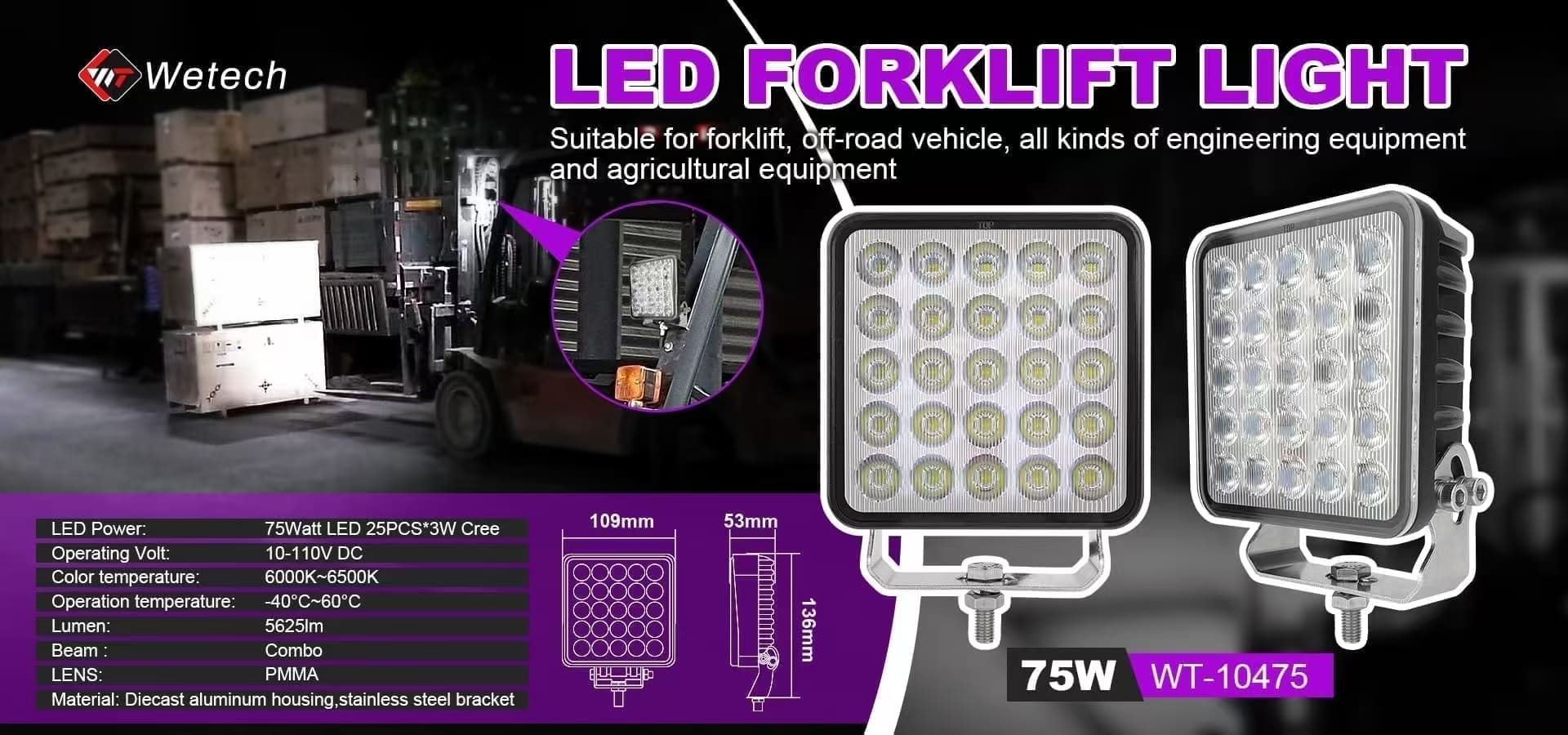
Our 75W Universal Square LED Work Light can also be customized to forklift-specific voltages, delivering up to 5625 lumen. It combines spot and flood lighting, with optional warning light functions, to better support nighttime operations.
3.2 Beam Control and Targeted Lighting
High-performance forklift lights use structured beam design to direct light precisely where it is needed most—such as travel paths, aisle edges, and work zones. This focused layout improves visibility in critical areas without wasting light or creating unnecessary brightness that could affect operator comfort. Adjustable beam angles add flexibility for different environments, including narrow aisles, loading bays, and outdoor yards.
3.3 Wide-Angle Coverage
Lights with wide-angle optical design provide broader, more even illumination, improve peripheral vision, and reduce shadow buildup around the forklift. A strong wide-angle light lights up the entire work area instead of just a small spot, helping operators monitor more of their surroundings at once. Adjustable angles support use across narrow aisles, loading areas, and outdoor work zones.
4. OSHA Guidelines for Forklift Lighting on Night Shifts
Under OSHA standard 29 CFR 1910.178, forklifts must be equipped with lighting sufficient to illuminate the operator’s path and nearby hazards—a requirement that becomes even more important for night operations. OSHA incident reports frequently list insufficient lighting and reduced visibility as contributing factors in forklift-related incidents, and the agency stresses that proper lighting is a key part of workplace safety compliance.
Many facilities mistakenly believe basic lighting is enough to meet OSHA guidelines, but the agency emphasizes lighting that reduces blind spots and eases operator strain. Poor lighting not only creates safety risks but can also lead to fines and penalties for non-compliance. Choosing high-quality forklift lights is one of the most straightforward ways to support safer conditions for night-shift teams and maintain compliance.
Conclusion
Night-shift forklift operations do not have to carry unnecessary risk. Proper forklift lighting is a simple, cost-effective way to improve operator alertness, reduce fatigue-related errors, and lower visibility risks—while staying aligned with OSHA guidelines.
By prioritizing brightness, stable light output, wide-angle coverage, and durability, you can create a safer workplace for your night-shift team, reduce the chance of avoidable incidents, and keep operations running smoothly.
If your operation faces safety challenges during night shifts, or if your current lighting contributes to operator fatigue and visibility issues, we are here to help. Our forklift lighting solutions deliver bright, stable, and durable lighting to support safer operations and help your team work comfortably—even after dark.



Phone : +86 -13924120087
Email : info@wetechhk.com
Address : UNIT NO.532B ON 5/F, STAR HOUSE, NO.3 SALISBURY ROAD, KOWLOON,HONGKONG
Copyright @ 2026 Wetech Electronic Technology Limited All Rights Reserved.  Network Supported
leave a message
Scan to Wechat :

Scan to WhatsApp :