Busy warehouses, logistics yards, and manufacturing facilities often have forklifts and pedestrians sharing tight spaces—and that means constant risk. Collisions, mix-ups, and other avoidable incidents happen all too easily when people and equipment are working close together. One simple but effective way to cut down on these risks? Clearly mark the “danger zones” around your forklifts. These are the areas where the forklift moves, turns, or lifts loads—spots where pedestrians need to slow down, pay extra attention, or stay away entirely. Forklift safety lights aren’t just for helping operators see where they’re going, either. They’re a key tool for visual communication, making those danger zones easy to spot and keeping everyone on your site safer.
There’s no single “perfect” way to install forklift safety lights—every facility is different. You might have a wide-open space with lots of foot traffic, or narrow aisles where visibility is tight. Your layout, how people move, and your specific safety needs all play a role. That’s why we’ve put together a practical, easy-to-use lighting template to help you create clear, easy-to-recognize danger zones around your forklifts. This template isn’t a rule you have to follow—it’s a flexible guide. It uses different types of safety lights in strategic spots to boost safety as much as possible. Below, we’ll walk you through this installation approach, explain why each light placement matters, and show how it helps cut down on risks in day-to-day operations.
The goal of this lighting template is simple: to make the forklift’s movement, direction, and danger zones visible at a glance—even in busy, noisy, or low-light environments. By using specific types of safety lights in key positions, can reduce the possibility of misjudgment, give pedestrians and operators more time to react, and create a more controlled, safer work environment.
1. Front of the Forklift: Arrow Beam Lights + ARC Beam Safety Zone Lights
Most forward travel and loading work takes place at the front of the forklift, so this area carries a higher risk of hitting pedestrians, nearby machinery, or racking. Adding two kinds of safety lights here — arrow beam lights and ARC beam safety zone lights — helps send clear signals about travel direction and nearby hazards.
Arrow Beam Lights, mounted on the front of the forklift, provide instant visual cues about the forklift’s intended direction, warning pedestrians and nearby workers to stand clear and anticipate movement. This eliminates the guesswork: instead of relying on hand signals (which can be missed in noisy or busy environments) or the forklift’s movement alone, everyone on site can see exactly where the forklift is heading.
When used with arrow lights, semi-circular safety zone lights cast a broad, curved light pattern onto the floor ahead of the forklift. This bright zone acts as a visible buffer that shows how far the forks or load can reach, and also covers the operator’s biggest blind spots. The curved shape is designed to cover the front and both sides of the machine, so pedestrians know to stay outside this area and avoid sudden turns or moving forks.
Together, these two lights solve two key front-end risks: they communicate direction to prevent misjudgment, and they mark a clear buffer zone to reduce collision risks with pedestrians or obstacles.
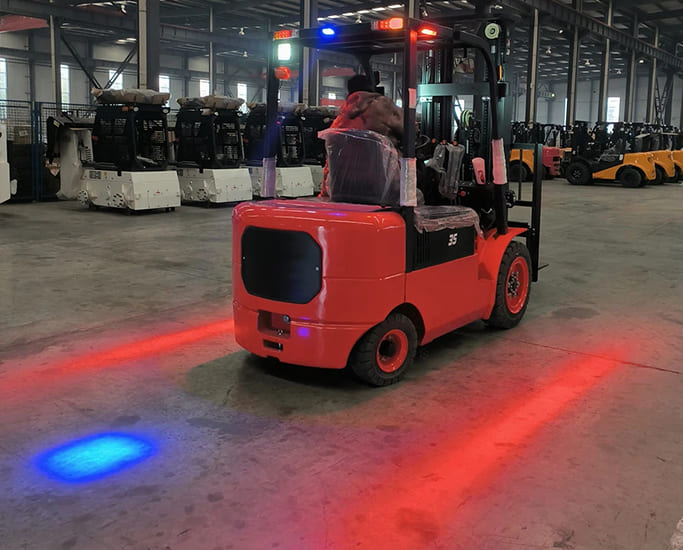
2. Sides of the Forklift: Line Beam Safety Zone Lights
People often overlook the sides of a forklift, yet they can be just as dangerous — especially when the vehicle is shifting sideways, turning, or working in narrow aisles. Pedestrians sometimes get too close without noticing a pending turn or a load that could swing out. Line beam safety zone lights, fitted on both sides, fix this by casting a long, slim line of light along the floor next to the machine.
These lights form a clear visible boundary that shows the full width of the forklift, including any load it’s carrying. The line is easy to spot even in busy areas, telling people at a glance to keep their distance. This is especially helpful in tight aisles where pedestrians might try to squeeze close to get past.
Linear lights also help operators judge the machine’s width in cramped spaces, lowering the chance of scraping racks or other equipment. With that clear visual marker on the ground, drivers can keep a safe gap from obstacles and make the whole workspace safer.
3. Rear of the Forklift: Spot Beam Lights
The rear of a forklift is a major blind spot for operators. Many collisions happen while reversing, because the driver often can’t see pedestrians or obstacles behind the machine. A spot beam safety light mounted at the rear fixes this by projecting a large, distinct circular dot onto the floor behind the forklift.
The main purpose of this single round warning light is to create a clear “no-entry” zone directly behind the forklift, marking the path the vehicle will take when backing up. This large, focused circular beam stands out easily from other lighting, so the warning remains sharp and obvious even in busy or well-lit facilities.
Unlike wide, bright beams that might distract other workers, this single circular warning light is subtle but effective. It delivers a clear danger signal without overwhelming the surrounding area. That’s why it works so well on the rear — it alerts people safely without causing unnecessary distraction.
4. Additional Option: Our Newly Launched Gobo Projectors Light Series
If the indicator lights we’ve covered don’t fully meet your on-site safety needs, you may want to explore our newly released Gobo Projector series.These lights are highly versatile — they can be installed in warehouses as well as directly on forklifts.As the forklift moves, they project a clear warning zone in real time. The biggest benefit is that the projected patterns are fully customizable.Popular options include turn signals, stop reminders, pedestrian zone markings, and more.This level of customization lets the Gobo lights match your unique workspace layout and safety rules, offering more focused and direct warnings than standard indicator lights.
Why This Flexible Template Works (And Why It’s Not Mandatory)
This lighting setup is meant to be flexible, not fixed. Every worksite is different — some are open with plenty of room for workers and equipment, while others have tight aisles and poor visibility. You can always adjust where you mount lights or which types you use based on your daily needs. For instance, if your warehouse has wide, open space for foot and vehicle traffic, you can use linear lights to fully box in the area around the forklift. If you work outdoors often, brighter lights work better than softer ones to cut through sunlight and fog.
For busy sites with a lot of foot traffic or complicated layouts, a gobo pattern projector can make danger zones even clearer. It projects sharp, custom patterns like “STOP” or warning signs directly onto the floor, making warnings much easier to notice than simple light beams.
The biggest strength of this template is that it covers the most accident-prone areas around a forklift: the front for direction and buffer space, the sides for width and boundaries, and the rear for blind spots and reversing. With the right lights in these spots, you build a year-round visual safety system that works just as well during busy daytime shifts as it does in dim night conditions.
Forklift safety lights work best when they’re part of a planned safety system, not just random add-ons. This guide helps you use each light with a clear purpose: marking hazardous areas, showing movement, and keeping everyone on-site safe.
Conclusion
Marking out clear danger zones around forklifts is one of the easiest and most cost-effective ways to cut down on workplace accidents and raise overall safety.There’s no official, mandatory way to install forklift safety lights, but the flexible layout we suggest works well in real situations: arrow and semi-circular zone lights at the front, linear zone lights along the sides, and a large round dot indicator at the rear.Each placement serves a clear safety job: front lights show travel direction and safe buffer space, side lights mark physical boundaries, and rear lights warn of reversing and blind-spot risks. By adjusting this template according to the unique needs of your facility, you can reduce the risks of misjudgment and collisions, and create a safer working environment for both forklift operators and pedestrians.
If you wish to upgrade your forklift safety lighting and create clear danger zones, we are here to help at any time. Our range of forklift safety lights ensures that safety doesn’t have to be complicated—install the right lights in the right positions to effectively protect your team and keep operations running smoothly.





 Network Supported