In the logistics and transportation industry, tail lifts are essential tools for loading and unloading goods at warehouse docks, roadside stops and delivery locations. However, these daily workhorses also come with significant safety risks, especially at night. Low-light conditions, busy dock operations and limited side visibility often leave pedestrians, forklift operators and passing vehicles unaware of an active tail lift until they are too close.
For fleet managers and warehouse operators, reducing tail lift-related accidents is not just a matter of compliance — it directly impacts personnel safety, operational efficiency and long-term cost control. This article will analyze the core reasons behind the high incidence of tail lift accidents at night, explain the limitations of traditional safety measures, and introduce the key criteria for selecting reliable tail lift warning lights for fleets.
Why Do Night-Time Tail Lift Operations Carry Higher Risks?
Accidents around tail lifts do not happen by chance. The root cause lies in the lack of visual cues in the working environment that people normally rely on to judge safety, which is mainly reflected in four aspects:
1. Greatly reduced boundary recognition: After nightfall, or in dimly lit warehouses and covered loading docks, a lowered tail lift blends into the surrounding ground. There is no clear visual boundary between the working zone and the pedestrian passage. Pedestrians may step into the tail lift working range without realizing it, and forklift operators are also prone to misjudging the safe distance when approaching the rear of the truck.
2. Natural blind spots from side views: From the side perspective, traditional reflective flags and stickers are almost invisible. Vehicles approaching from the side or passing personnel can hardly detect the position of the tail lift in time, significantly increasing the risks of side collisions and accidental intrusion.
3. Manual warnings are easy to overlook: Most manual warning devices rely on drivers or loading personnel to remember to turn them on. In high-intensity operations with multiple deliveries per day, it is easy for people to skip the step of turning on the lights, eventually forming silent and invisible safety hazards.
4. High risk of rear-end collisions during roadside loading: When a truck stops temporarily to unload, following vehicles often cannot recognize the working state in time on rainy, foggy days or in tunnels. Rear-end collisions are common causes of tail lift-related accidents.
Limitations of Traditional Tail Lift Safety Solutions
Most mainstream tail lift safety protections rely on passive or manual solutions, which have obvious shortcomings in actual operation scenarios. For example, reflective flags and stickers attached to tail lifts can only reflect light passively, depend on external light sources, and are almost invisible at night and from the side; painted floor markings on dock floors are only applicable to fixed docks, and cannot be used for mobile vehicles making multi-stop deliveries. None of these solutions can achieve both active light emission and automatic start-stop. Passive reflective accessories fail in the dark, and what is really needed is a warning solution that automatically activates when the tail lift enters the working state and is clearly visible from all directions.
Core Selection Criteria for High-Quality Tail Lift Warning Lights
The quality of tail lift warning lights varies greatly. To ensure reliable performance in night and dock operations, fleet managers must focus on evaluating four core indicators before bulk procurement:
1. Start-Stop Control: Different start-stop control methods can affect the convenience of staff. The tilt-sensing design enables the light to turn on automatically when the tail lift lowers to the working angle and turn off when it is stowed in place — no need to flip switches or press buttons, and no risk of starting work without safety protection.
2. Optical Performance: A high-quality strobe warning tail light can emit high-contrast intense flashes, which have strong penetrating power in the dark and bad weather. It should be clearly visible from the rear and both sides, ensuring that pedestrians and oncoming vehicles can receive the same level of warning. While steady marker lights have their value, strobe patterns are far more effective in grabbing attention in busy environments.
3. High Durability & Flexible Power Options: Installed on the side of the tail lift, the light is exposed to rain, road water spray, dust and constant vibration from driving and lifting all year round. An IP65-rated housing provides complete dust and water protection, and a rugged impact-resistant structure ensures a long service life under daily high-intensity use.We offer two power supply versions: rechargeable type and wired type, both with easy installation to fit different vehicle refitting demands.
4. Complete Compliance Certifications: Compliance certifications are crucial for fleet operation, especially for fleets in cross-border markets. It is necessary to confirm that the product has complete vehicle warning light performance certifications to ensure that it meets recognized safety and durability standards and can be deployed with confidence in different regions.
Wetech’s Strobe Warning Light Series Specifically Designed for Tail Lifts
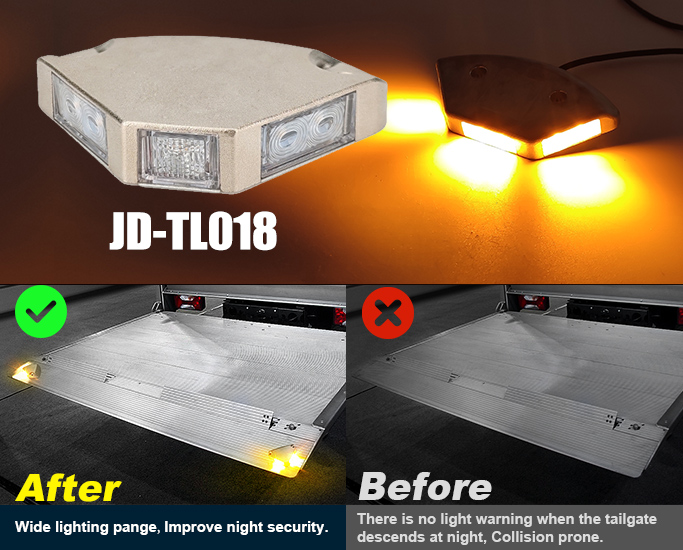
Wetech has designed a series of warning lights specifically for tail lift safety issues, aiming to accurately solve the visibility and reliability problems that cause most loading dock accidents. Featuring multiple shape options, it is a core basic configuration for tail lift safety.
Core Functions and Advantages
• Tilt-activated automatic start-stop: Turns on automatically when the tail lift lowers to the working position and shuts off when it rises back to the driving position. No manual operation is required throughout the process, providing full protection even during high-intensity multi-delivery operations per day.
• High-brightness LED strobe: High-contrast flashing effect, clearly visible from the rear and both sides. Far superior to traditional side-invisible reflective solutions, it can clearly convey the working state in dim environments.
• IP65 protection rating: Fully dustproof and waterproof, resistant to rain, mud, dust and continuous vibration, suitable for all-weather outdoor operations.
• Complete international certifications: Passed relevant vehicle warning light performance certifications, complying with the compliance requirements of global markets.
• Rugged and durable structure: Impact and vibration resistant, adapting to the long-term driving of vehicles and the frequent lifting of tail lifts.
For fleet managers, this means a long-term low-maintenance safety upgrade after one installation: once installed, it can operate reliably in every shift without additional operation by drivers or recurring consumable costs.
Add-On Upgrade Solution: Red Line Warning Light
For docks with heavy pedestrian and forklift traffic, the JD-TL018 strobe light can be paired with the WT-102010-1 linear beam warning light to achieve a higher level of double-layer protection:
• The strobe tail light provides long-distance status reminders to let personnel know in advance that the vehicle is in operation.
• The linear beam warning light projects a red light strip on the ground to accurately mark the danger zone boundary and clarify the restricted area to avoid.
This combination is very suitable for scenario upgrades of 24-hour uninterrupted loading and unloading operations in distribution centers.
Core Application Scenarios
These lights deliver the most prominent value in environments with naturally limited visibility and high operation intensity, mainly covering four types of scenarios:
1. Warehouse Loading Docks: In indoor and covered docks with insufficient ambient light, the auto-on strobe light allows forklift operators and warehouse staff to instantly identify active tail lifts, greatly reducing side collisions and accidental intrusion by personnel.
2. Night Roadside Delivery: When unloading at temporary stops, the eye-catching flash alerts following drivers to the working vehicle much earlier, significantly reducing the risk of rear-end collisions during roadside loading.
3. Tunnels and Underground Loading Areas: These places have insufficient light all year round, where passive reflective accessories perform poorly. The active luminous strobe warning maintains high visibility from long distances, making up for the failure of traditional solutions.
4. Fleet Standardized Safety Upgrade: Uniform deployment of the same fully certified product across the entire fleet not only unifies safety protection standards but also simplifies compliance management and makes safety audits clearer and smoother.
Conclusion
Most tail lift accidents during night loading and dock operations are preventable. The high incidence of accidents is not due to personnel negligence, but the over-reliance on passive, manual and easily overlooked safety methods — these methods are not designed for the fast-paced logistics operation environment from the beginning.
A tilt-activated strobe warning light specifically designed for tail lifts solves the core problem from the root: it automatically provides full-process, all-angle visible warning when the tail lift enters the working state, requires no additional operation by drivers, can withstand harsh vehicle operating conditions, and meets global compliance standards. For sites requiring higher protection levels, adding a red line projection light can further strengthen the boundary warning effect.
For warehouse operators and fleet managers looking to reduce loading dock accident rates and improve safety compliance, upgrading tail lift warning lights is one of the most straightforward and cost-effective measures. If you want to learn more about Wetech’s vehicle tail light styles, their upgrade solutions, certification details, etc., welcome to contact us for customized solution recommendations.
Frequently Asked Questions
1. Do tail lift warning lights only work at night? No. They are most effective at night, but the strobe pattern also has high recognition in daylight, providing clear warnings around the clock.
2. Do I need to turn the light on and off manually? No. The tilt-sensing model will turn on automatically when the tail lift lowers and turn off when it is stowed, without manual operation.
3. Are they waterproof for outdoor use? Yes. High-quality products all reach IP65 protection rating, with efficient dust and water resistance, designed for all-weather outdoor operations.
4. Can I add ground projection later if I only install strobe lights first? Yes. The strobe warning light itself is a complete independent solution, and the linear beam projection light can be added as an upgrade at any time to adapt to sites with higher protection needs.





 Network Supported