Heavy construction machinery such as excavators, loaders and bulldozers operate around the clock on rugged outdoor job sites. Constant vibration, heavy dust, rain exposure and unstable vehicle voltage all subject work lights to high-intensity wear and tear. For most fleet managers and equipment owners, selecting work lights solely based on lumen count and price often leads to frequent burnouts, water damage, loose brackets and dimmed output, resulting in unexpected downtime and rising maintenance costs.
This guide starts from the actual working condition requirements of heavy construction equipment, sorts out 6 core hard criteria for selection, and provides model selection references for different types of equipment, to help you choose durable and reliable LED work lights that truly adapt to harsh construction site environments.
Core Performance Requirements for Work Lights on Heavy Construction Equipment
Before comparing specifications, it is essential to align product performance with real working scenarios. Heavy construction sites impose far higher demands on lighting than ordinary on-road vehicles:
· Strong vibration resistance: Heavy machinery generates continuous high-frequency vibration during operation, which can easily loosen internal wiring, desolder LED beads and cause bracket displacement.
· All-weather dust and waterproof protection: Construction sites are dusty and rainy, and often require high-pressure water washing. Sealing performance directly determines service life.
· Wide voltage adaptability: Voltage fluctuates drastically during equipment startup, idling and operation; inferior lamps are easily damaged by instantaneous surges.
· Long-term thermal stability: Night shifts often require continuous lighting for hours; poor heat dissipation leads to rapid light decay and shortened service life.
· Impact and scratch resistance: Flying debris, bumps and scratches are common on site; housings and lenses must have sufficient physical strength.
6 Key Selection Criteria to Avoid 90% of Low-Quality Products
1. Heat Dissipation: Prioritize One-Piece Die-Cast Aluminum Housings, Reject Plastic or Thin Sheet Metal
High temperature is the number one enemy of LED lifespan. Inferior work lights use plastic or thin sheet-metal housings with almost no effective heat conduction, causing internal heat to build up rapidly, burn out LED beads and accelerate light decay.
For construction equipment, a one-piece die-cast aluminum housing is the baseline requirement. The integrated aluminum structure acts as a full-body heat sink, conducting heat away from the light source quickly and evenly. Its thermal efficiency and durability are far superior to spliced aluminum sheets or plastic shells, and it directly extends lamp life under long hours of continuous operation.
2. IP Rating: Choose IP67 or Higher Based on Scenarios
IP rating is the most intuitive indicator of dustproof and waterproof performance. It should be selected according to actual cleaning and operating environments:
· IP67: Suitable for most conventional construction sites. It completely blocks dust, withstands temporary immersion and regular water rinsing, and meets daily rain and dust protection needs.
· Ratings above IP67: Deliver higher-grade protection and can withstand high-pressure, high-temperature water jet washing.
A reliable IP rating relies on sealing structure rather than paper parameters. Industrial-grade silicone sealing rings combined with full potting technology are far more dependable than ordinary rubber gaskets.
3. Light Source Quality: Prioritize Industrial-Grade Branded LED Beads, Do Not Blindly Pursue High Lumens
Many buyers fall into the misconception that “higher lumens equal better quality”. In fact, for construction machinery, high-temperature resistance and low light decay matter more than peak lumen values. Generic no-name beads often claim high lumens but degrade extremely fast under high temperature, losing more than half their brightness within a few months.
Prioritize products equipped with well-known industrial-grade LED beads. Branded chips feature stable color temperature, reliable high-temperature performance and ultra-low light decay, maintaining consistent brightness over years of service.
4. Beam Pattern: Choose Flood, Spot or Combo Beam According to Mounting Position
Beam pattern directly determines lighting efficiency and should be selected based on installation position and working purpose:
· Flood beam: Wide coverage and uniform light, suitable for body side lighting, cab supplementary lighting and surrounding area illumination.
· Spot beam: Concentrated beam and long range, suitable for excavator booms, front-end lighting and long-distance working visibility.
· Combo beam: Mixed flood and spot output. One lamp covers both near and far vision, making it the most versatile choice for unified procurement across multiple positions.
5. Electrical Adaptability: Wide Voltage Design Is a Must for Construction Vehicles
The electrical system of construction machinery fluctuates greatly during startup, acceleration and idling. Lamps without voltage stabilization and surge protection are easily damaged by instantaneous current shocks.
Models with 9–80V or 9–96V wide voltage input are recommended. They can stably adapt to various 12V, 24V and 48V vehicle systems and avoid burnout failures caused by voltage instability.
6. Lens & Mounting: Impact-Resistant Lens + Reinforced Bracket Are Indispensable
Lenses and mounting brackets are easily overlooked details, yet they determine long-term reliability:
· Lens: Original PC optical lens is preferred, with high light transmittance, strong impact resistance and yellowing resistance, remaining clear after years of outdoor use; lenses made of recycled mixed materials easily become foggy and yellow.
· Mounting bracket: Heavy equipment generates strong vibration, and ordinary thin brackets easily loosen, sag or break. Thickened and reinforced brackets with a firm locking structure must be selected to ensure the lamp stays stable and does not shift under long-term vibration.
Equipment-Specific Recommendations for Common Heavy Construction Machinery
Excavators & Wheel Loaders
Install spot beam lamps on the boom for long-distance front visibility, and flood beam lamps on both sides of the body for surrounding lighting. For unified fleet configuration, combo beam models are the most cost-effective choice. Focus on vibration resistance and waterproof rating.
Bulldozers & Road Rollers
Mainly require wide all-around flood lighting. Prioritize flood beam lamps, with emphasis on high protection rating, impact resistance and wide voltage adaptability.
Dump Trucks & Construction Trucks
Mainly used for side and rear supplementary lighting. Choose flood or wide-spot beams, focusing on anti-glare design, mounting stability and rain resistance.
Compact Construction Equipment
For skid steer loaders, mini excavators, small forklifts and other equipment, choose compact-sized work lights, focusing on flexible installation, vibration resistance and durable build.
Wetech Heavy-Duty LED Work Light Solutions
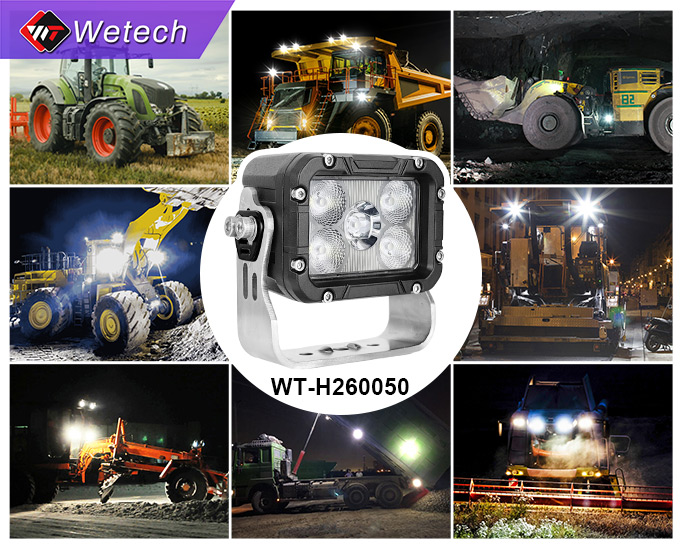
Wetech is a professional manufacturer of machinery lighting equipment. Targeting the common problems in heavy machinery operation, we have developed an upcoming line of industrial LED work lights built for harsh construction site conditions. The full series is designed in line with the above selection criteria and adopts industrial-grade configurations.
To address the common pain point of loose brackets on heavy machinery, we have specially developed and upgraded thickened and reinforced mounting brackets. The thicker metal structure paired with a reinforced locking design stays firmly fixed under long-term high-intensity vibration, without loosening, shifting or poor contact.
We offer a full lineup of 6 models from low to high power, covering all needs from supplementary lighting for small equipment to high-power main lighting. A single supplier can meet the unified procurement needs of different equipment and different mounting positions.
For bulk project orders and urgent fleet upgrade needs, contact us in advance to secure priority production and delivery scheduling.
Conclusion
When selecting LED work lights for heavy construction machinery, the core is not to pursue the highest lumens or the lowest price, but to match performance with actual working conditions.
Heat dissipation structure, IP rating, light source quality, beam pattern, voltage adaptability and mounting reliability are the six hard indicators that determine the actual durability and long-term value of lamps. Although qualified industrial-grade work lights have a slightly higher upfront cost, they can greatly reduce replacement frequency and downtime losses, resulting in a lower total cost of ownership over the full life cycle.
If you need professional model selection for your construction fleet, or have requirements for bulk procurement and priority supply, welcome to contact Wetech for customized lighting solutions.
Frequently Asked Questions
· Can I replace original halogen work lights with LEDs directly? Do I need to rewire?
In most cases, direct replacement is possible. Our LED work lights adapt to common vehicle voltage ranges and can usually be connected directly to the original wiring harness without modification. For very old equipment, we recommend checking the connector and voltage specifications first.
· What color temperature is most suitable for construction site work?
5700K–6000K cool white light is the most widely used. It delivers clear and sharp visibility, causes less visual fatigue during long night shifts, and is suitable for earthmoving, loading, road construction and most other scenarios.
Is it normal for LED work lights to dim after half a year of use?
No, it is not normal. High-quality industrial-grade LED work lights with proper heat dissipation and branded beads should maintain over 90% of their initial brightness after thousands of hours of use. Obvious dimming within half a year is almost always caused by poor bead quality and defective heat dissipation design.
· Which is better for excavators: combo beam or flood beam?
For front lighting on the boom, spot beam is preferred; for surrounding lighting on the body, flood beam is more suitable. If you want to standardize one model across the entire fleet, combo beam offers the best balance and cost performance.





 Network Supported