Walk into any modern logistics warehouse or distribution center, and you will see the same picture: forklifts, pedestrians, racking aisles and loading docks all overlapping in a constant flow of activity. Mixed traffic is simply the reality of how warehouses run today. But that reality comes with a cost — collisions, workers wandering into active work zones, and forklift-related incidents remain stubbornly high across the industry.
Here is the thing about most of these incidents: they are rarely caused by careless operators. More often than not, the real issue is that boundaries are not clear enough. Pedestrians do not know where the safe walkway ends. Forklift drivers struggle to judge the extent of a danger zone. And temporary work spots often have no visual cue at all.
Traditional warehouses have long relied on painted floor lines, reflective tape and signage to mark aisles and hazard zones. The problem? These are all passive solutions, and in a busy warehouse they tend to fail when you need them most. In this article, we will break down why traditional floor markings fall short, explain how safety laser lights solve the problem at its source with active projection, and share what to look for when choosing a system for your own facility.
Why Traditional Floor Markings Keep Failing
Almost every warehouse safety system starts with the same basic idea: paint a line on the floor. It sounds simple enough. But in a real, high-frequency warehouse environment, that painted line ends up costing more and delivering less than most managers expect. The problems usually fall into three buckets.
1. They wear out fast, and maintenance is expensive
Forklift tires rolling over the same spot day after day, pallets being dragged across the floor, goods being shifted around — all of this adds up. Painted lines start cracking, peeling and fading within weeks in a busy facility. That means someone has to go back and repaint them on a regular schedule. And repainting usually means partially shutting down the affected area, which eats into both labor costs and operational throughput.
2. They disappear in low-light conditions
Paint and reflective tape are passive reflectors — they only work when there is enough ambient light bouncing off them. Head to the back of a deep racking aisle, a dim corridor corner, an enclosed loading dock or an underground storage area, and those markings become much harder to spot. In those conditions, pedestrians and forklift operators simply do not see the boundary in time.
3. Changing the layout is a genuine headache
Warehouse layouts are not static. Peak season means extra sorting areas. Promotional periods mean temporary stock storage. Equipment maintenance means an aisle gets blocked off for a few days. All of these changes require safety boundaries that can adapt quickly. But once paint is on the floor, changing it means scraping up the old line, re-measuring, repainting and waiting for it to dry. It is messy, time-consuming, and the fumes and dust do not help either. Reflective tape is not much better — peel it off and you are usually left with sticky residue that is a pain to clean. The end result? Temporary work zones often end up with no markings at all, and that is where hazards creep in.
The bottom line is straightforward: passive markings depend on external light, need constant upkeep, and cannot be adjusted quickly enough for modern warehouse operations. What warehouses actually need is a safety boundary that glows on its own, never wears out, and can be redeployed in minutes.
(WT-TZ8021-G1)
How Safety Laser Lights Actually Improve Warehouse Safety
The concept behind safety laser lights is refreshingly simple. A dedicated fixture projects a bright, straight line onto the floor — available in red, blue, green and other colors — creating a clear, continuous visual boundary. The key difference from paint is that this line emits its own light. It does not depend on ambient illumination, and it never touches the floor, which means it sidesteps all three major problems of passive markings.
1. Active illumination means visibility everywhere
The projected laser line produces high-contrast light in your choice of color, and it stays consistently recognizable whether you are in a bright main aisle, a dim racking tunnel, or a loading dock where sunlight and shadow shift throughout the day. The moment a pedestrian or forklift driver enters the field of view, they see the boundary — no extra lighting required.
2. Zero wear, basically no maintenance
Because the line is projected rather than applied, there is no contact with the floor. No rolling wear, no drag scratches, no peeling. Set it up once, calibrate the angle, and that line stays projected consistently for the long term. No repainting schedules, no shutdowns for worn markings — and over time, that adds up to real savings on safety management costs.
3. Flexible deployment, and you can change zones anytime
This is where laser lights really pull ahead of paint. Instead of scraping and repainting, you just loosen the bracket screws, adjust the projection angle, and retighten. When the warehouse layout shifts, when you add a temporary work zone, or when seasonal reconfiguration rolls around, you can have a new boundary in place within a few minutes. No scraping, no painting, no waiting for things to dry, no fumes or dust. It fits the way modern warehouses actually operate.
4. The visual warning effect is genuinely stronger
A bright projected line on the floor creates a clear psychological "do not cross" signal. Both research and real-world deployments bear this out: actively illuminated lines get more attention than passive paint. Pedestrians instinctively avoid the lit zone, and forklift drivers can judge their working range more precisely. That behavioral shift is where the real accident reduction comes from.
What to Look for When Choosing Warehouse Safety Laser Lights
No two warehouses are exactly alike. You might have a dry ambient-temperature facility or a humid cold-storage warehouse. You might need fixed main aisle markings or dynamic zones that move with forklifts. When evaluating options, keep these five factors front of mind.
1. Power supply type
The power source dictates where the fixture can realistically be used. DC models offer a wide voltage range and can tap directly into the onboard power of forklifts, AGVs and tractors, making them ideal for projecting dynamic safety zones that move with the equipment. AC models, on the other hand, run on standard mains power and are meant for fixed mounting — ceilings, walls, overhead structures — where they project long-term boundaries for main aisles and loading docks.
2. Projection distance and line length
Different mounting heights produce different line lengths. Before buying, work out your mounting height and aisle width, then make sure the projected line fully covers the boundary without falling short or spilling over into unrelated areas. Most manufacturers provide a projection-distance-to-line-length reference table, which makes this straightforward to check.
3. Protection rating
The IP rating tells you what kind of environment the fixture can handle. For a dry, clean warehouse at normal temperatures, a basic IPX4 rating is usually enough. But if your facility is humid, dusty, uses wash-down procedures, or includes cold-storage areas and outdoor loading zones, you will want IP65 or higher to keep dust and moisture out of the housing and protect the lifespan of the unit.
4. Adjustable line width
Aisles in a warehouse are rarely all the same width. Main aisles are wide, branch aisles are narrow, and work zones vary in size. If the fixture supports line width adjustment — usually via an accessory — you can fine-tune the thickness and coverage of the projected line to suit different layouts. One fixture model covers more scenarios, you carry less inventory, and reconfiguration becomes much simpler.
5. Operating temperature range
Most warehouses stay within a mild temperature range, but cold-storage facilities, outdoor docks and unheated warehouses in colder climates can push well outside that. Check that the fixture operating temperature covers your actual environment — the last thing you want is brightness dropping off or the unit failing to start when the temperature hits an extreme.
These five dimensions give you a complete framework for evaluating warehouse safety laser lights. Everything from power supply and projection quality to protection rating and environmental adaptability affects the real-world experience and the actual safety outcome. With those requirements in mind, Wetech offers two targeted safety laser light products, each built for one of the two core scenarios: mobile onboard use and fixed-aisle long-term deployment.
(WT-TZ8021-R1)
Wetech Warehouse Safety Laser Lights
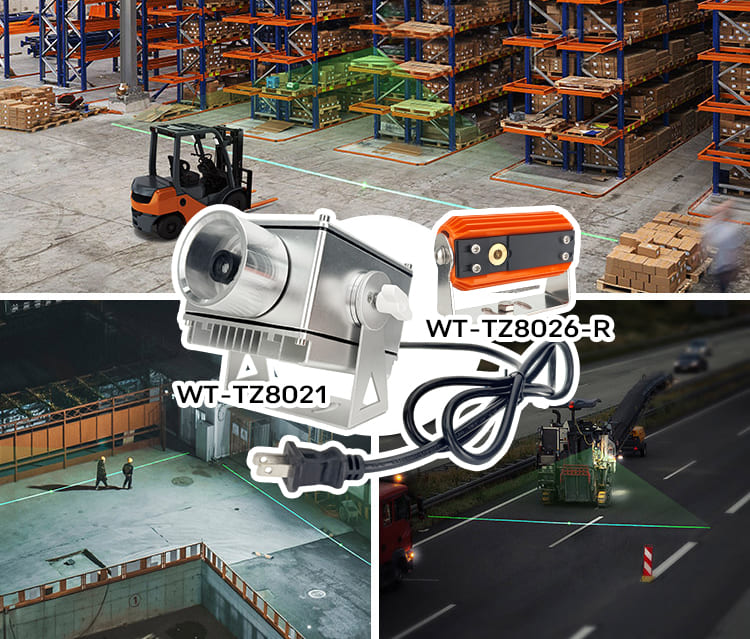
WT-TZ8021 — DC Onboard Model for Mobile Equipment
The WT-TZ8021 is a DC-powered laser safety light built specifically for mobile equipment. Think of it as a dynamic safety line that travels wherever the machine goes.
● Wide voltage compatibility: Supports DC 10–110V input, connects directly to the onboard power of forklifts, AGVs, tractors and other industrial vehicles — no extra transformer needed
● High-power light source: 500MW output, with red, blue, green and other custom colors available (standard model uses 638nm red); bright, strong penetration, projection distance 1–7m corresponding to line length 4.5–28m, covering most onboard operation scenarios
● Built to take a beating: Die-cast aluminum housing with good heat dissipation, impact and vibration resistant; IPX4 protection rated for onboard mobile environments; operating temperature -20°C to 70°C, lifespan over 10,000 hours
● Compact and flexible: Measures just 80×60×36.6mm, so it does not take up valuable space; mount it on top of the forklift, on the side, or on the overhead guard to project a dynamic safety boundary in real time as the vehicle moves
This model is especially well suited to forklifts, AGVs and other mobile equipment. Wherever the vehicle travels, the safety light projects with it, so surrounding pedestrians and other vehicles always have a clear sense of the machine working range.
WT-TZ8026-R — AC Fixed-Aisle Model with Adjustable Line Width
The WT-TZ8026-R is an AC-powered laser safety light designed for fixed aisles. Its whole purpose is to be a long-term, stable, flexibly adaptable boundary line that stays put and keeps working.
● Wide voltage mains input: Supports AC 100–260V, plugs straight into standard warehouse power, suitable for fixed mounting on ceilings, walls and columns
● Stable light projection: 14.1mW output, with red, blue, green and other custom colors available (standard model uses 650nm red); projection distance 1–9m corresponding to line length 4–28m, covering everything from narrow branch aisles to wide main thoroughfares
● Adjustable line width: Comes standard with a line width adjustment accessory, so you can fine-tune the thickness and coverage of the projected line based on aisle width; one fixture handles aisles of different sizes, and reconfiguration is quick and painless
● High protection and wide temperature range: Die-cast aluminum housing, IP65 rated for dust and water protection; operating temperature -40°C to 70°C, built for harsh environments including cold-storage warehouses, humid storage areas and dusty loading zones, lifespan over 10,000 hours
This model is the right choice for long-term deployment in fixed scenarios: warehouse main aisles, pedestrian-vehicle segregation zones, loading dock boundaries, cold-storage aisles and more. Install it once and it projects a clear boundary consistently. The adjustable line width also means it can keep up when your warehouse layout changes.
Practical Tips for Getting the Best Results
How well safety laser lights work depends not just on the product itself, but also on how you install and use them. Here are a few tips that have been validated in real deployments.
On mounting height: For fixed fixtures, aim for a mounting height of 3 to 5 meters. At that height, the projected line fully covers the aisle width without being constantly blocked by pedestrians or forklifts. For onboard models, mount them on top of the overhead guard or at a high point on the side of the vehicle, so cargo does not get in the way of the projection.
On aisle layout: For main aisles with mixed pedestrian and vehicle traffic, consider mounting fixtures on both sides facing each other. A projected line on each side creates a "dual-line corridor" effect that reinforces boundary awareness more strongly than a single line on one side. For loading dock edges, project a continuous line along the edge of the dock to make it unmistakably clear that this is a drop-off hazard zone.
Wrapping Up
The core challenge with warehouse aisle safety really comes down to one mismatch: traditional floor markings are passive, but modern warehouse operations demand something dynamic, efficient and low-maintenance. Paint wears out fast, disappears in low light, and is genuinely inconvenient to reconfigure — it simply does not keep up with what high-frequency warehouses need today.
Safety laser lights address these problems at the source through active illumination, zero wear and flexible deployment. They do not rely on ambient light, so they stay highly recognizable in any area. They do not touch the floor, so one installation keeps working for the long term. And their adjustable angles mean zone boundaries can be changed anytime, adapting quickly to shifts in warehouse layout.
Wetech two safety laser light products — the WT-TZ8021 DC onboard model and the WT-TZ8026-R AC fixed model — cover the two main scenarios of mobile equipment and fixed aisles respectively. Use them individually or pair them together to build a complete warehouse safety boundary system. For warehouse operators looking to bring down accident rates, cut safety maintenance costs and raise the overall level of safety management, safety laser lights are one of the highest-return safety upgrades you can make.
If you are planning a safety laser light solution for your warehouse, or you would like selection advice and pricing tailored to your specific scenarios, get in touch with Wetech. We will work with you to put together a customized warehouse safety boundary solution.
Frequently Asked Questions
1. Are safety laser lights visible in a bright warehouse?
Yes. Laser light maintains high contrast under most indoor lighting conditions, and higher-power models remain clearly visible even in strong ambient light.
2. Is installation complicated? Do I need a professional?
Not really. The fixed model (WT-TZ8026-R) connects to standard AC power, and the onboard model (WT-TZ8021) connects to vehicle DC power. Adjust the projection angle, fix the bracket, and you are done — no complex construction required. Most warehouse maintenance staff can handle it following the manual.
3. Are the lasers safe for human eyes?
Safe. Warehouse safety laser lights use safety-class lasers that will not harm human eyes under normal use. During daily operations, personnel see the light projected on the floor, not the direct light source, so it is completely safe. Simply avoid staring directly into the fixture outlet for extended periods. Of course, it is important to select appropriate products in accordance with local government regulations governing this type of lighting.
4. Can they be used in cold-storage warehouses?
Absolutely. The WT-TZ8026-R supports a wide operating temperature of -40°C to 70°C with IP65 protection, making it suitable for cold-storage warehouses, humid storage areas, dusty loading zones and other harsh environments. It keeps projecting a clear line even at low temperatures.
5. Do the laser lines wear out? Do they need repainting?
No. Safety laser lights are projected markings that do not contact the floor, so there is no rolling wear or drag scratching. Once installed and calibrated, the line stays projected consistently for the long term — no repainting, no shutdowns for worn markings.
6. What if my aisles have different widths? Do I need different models?
Not necessarily. The WT-TZ8026-R comes standard with a line width adjustment accessory, so you can fine-tune the thickness and coverage of the projected line based on aisle width. One fixture can handle aisles of different widths. If the width difference is especially large, you can also adapt by adjusting the mounting height and projection angle.
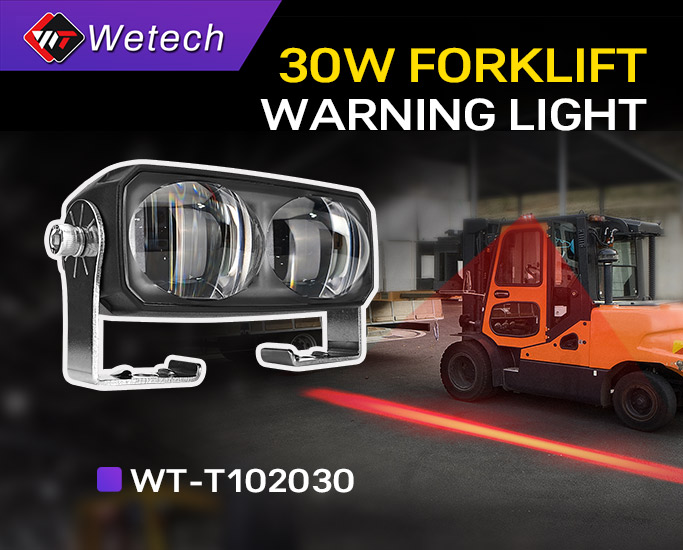
In busy warehouses and industrial environments, forklift safety isn’t just a priority—it’s a critical requirement. Every year, preventable accidents involving forklifts lead to injuries, downtime, and costly liabilities. The solution? Investing in advanced safety lighting like the Wetech 30W WT-T102030 Forklift Warning Light, designed to dramatically improve visibility and reduce collision risks.
The Hidden Dangers of Poor Forklift Visibility
Forklifts operate in tight spaces, low-light conditions, and high-traffic areas where pedestrians and other machinery share the floor. Traditional warning systems often fail to cut through the noise, leaving operators and workers unaware of approaching vehicles. This lack of clear visibility is a leading cause of workplace incidents, making it essential to adopt proactive safety measures.
What Makes the WT-T102030 Stand Out?
The Wetech WT-T102030 is engineered specifically for industrial forklift safety, combining powerful performance with durable design:
1. 30W High-Intensity Red Zone Lighting
This warning light projects a bright, crisp red line onto the ground, creating a clear "safety zone" around the forklift. The 30W LED output ensures the line is visible even in bright daylight or dim warehouse conditions, alerting pedestrians and nearby workers to maintain a safe distance.
2. Rugged, Industrial-Grade Build
Built to withstand the harsh demands of daily industrial use, the WT-T102030 features a heavy-duty aluminum housing and shock-resistant lens. It resists vibration, dust, and moisture, making it reliable for long-term operation in warehouses, construction sites, and manufacturing facilities.
3. Easy Installation & Compatibility
Designed for hassle-free setup, the WT-T102030 mounts directly to most forklift models with minimal wiring. It operates on a wide voltage range (typically 12V–80V), ensuring compatibility with all major forklift brands and electrical systems.
4. Energy-Efficient LED Technology
Unlike outdated halogen lights, the WT-T102030 uses energy-efficient LEDs that consume less power while delivering brighter, more consistent light. This reduces strain on the forklift’s battery and lowers long-term maintenance costs.
How the WT-T102030 Improves Workplace Safety
Implementing the WT-T102030 warning light transforms forklift operations in several key ways:
Clear Visual Boundaries: The red zone light acts as a physical barrier, reminding workers to stay clear of the forklift’s path.
Increased Awareness: The bright red line is impossible to miss, even in noisy or distracted environments, reducing the risk of accidental collisions.
Compliance with Safety Standards: Many regulatory bodies recommend or require visible warning systems for industrial vehicles, and the WT-T102030 helps meet these standards.
Reduced Downtime: Fewer accidents mean less downtime for repairs, training, and investigations, keeping operations running smoothly.
Who Can Benefit from the WT-T102030?
This 30W warning light is ideal for:
Warehouses & Distribution Centers: High-traffic areas where forklifts and pedestrians work side-by-side.
Manufacturing Facilities: Factories with complex layouts and multiple work zones.
Construction Sites: Outdoor environments with uneven terrain and variable lighting.
Logistics & Freight Companies: Fleets of forklifts operating in loading docks and storage areas.
Final Thoughts: Invest in Safety, Protect Your Team
Forklift safety is an investment in your team, your operations, and your bottom line. The Wetech 30W WT-T102030 Forklift Warning Light is a cost-effective, high-impact solution that turns potential hazards into visible safety zones.
If you’re ready to enhance your forklift safety protocols, the WT-T102030 is the reliable choice for industrial-grade performance and peace of mind.




 Network Supported