In warehouses, logistics yards, and production workshops, forklifts are the core equipment for boosting work efficiency—they’re used almost throughout the entire process of loading, unloading, and transporting goods. But at the same time, safety accidents caused by forklift operations are common. They not only result in injuries, deaths, and property damage but also disrupt production schedules, bringing unnecessary losses to businesses. This article breaks down common types of forklift accidents, analyzes their root causes, and provides actionable improvement solutions to help businesses reduce forklift operation risks in a low-cost, efficient way.
Common Types of Forklift Safety Accidents (Key Overview)
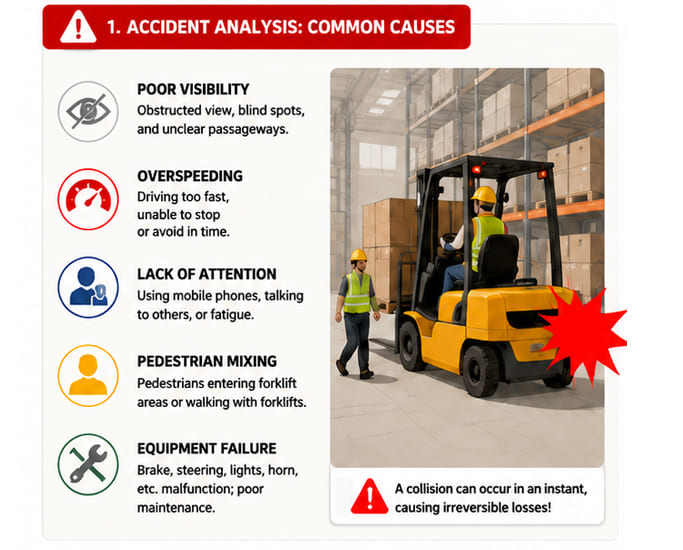
Most forklift accidents happen during operations, involving operator actions, equipment operation, and environmental interactions. The following 6 types are the most common, accounting for over 80% of all incidents:
1. Pedestrian-Forklift Collisions & Run-Overs: The most frequent type, usually caused by operator carelessness, speeding, or pedestrians randomly walking through forklift work areas;
2. Forklift Rollovers: Often occur when turning too fast, overloading, or working on slippery, uneven surfaces—these are likely to injure the operator;
3. Load Falling Injuries: Caused by improper load stacking, incorrect fork angle, or forklift hydraulic system failures, leading to loads tipping over and injuring people or equipment;
4. Blind Spot Collisions When Reversing: Forklifts have significant blind spots at the rear. When operators reverse, they may not see pedestrians or obstacles behind the vehicle, resulting in collisions;
5. Scratching Accidents in Narrow Aisles: In narrow aisles or around corners, forklifts are prone to scraping shelves, equipment, or even crushing people when turning or passing other vehicles;
6. Illegal Operation Accidents: Hidden dangers caused by human error, such as unlicensed operators, carrying passengers illegally, overloading, or working while fatigued.
In-Depth Analysis of Root Causes of Forklift Safety Accidents
Forklift accidents are not accidental—they’re mostly caused by a combination of four factors: “people, environment, equipment, and management.” Among these, human factors and lack of equipment protection account for the highest proportion:
1. Human Factors (Accounting for About 50%)
This is the main cause of accidents, rooted in weak safety awareness and non-standard operations. For example, unlicensed operators who are unfamiliar with forklift operation skills; speeding, turning without sounding the horn, or not wearing seatbelts during work; some pedestrians have insufficient safety awareness, randomly crossing forklift work areas or loitering around forklifts—all these behaviors can easily lead to accidents.
2. On-Site Environmental Factors
Unreasonable working environments directly increase accident risks. For instance, narrow warehouse aisles with no clear separation between pedestrian and forklift traffic; insufficient on-site lighting, with a lot of blind spots around corners and shelves; slippery, uneven floors that easily cause forklifts to skid or roll over.
3. Equipment Management Factors
Many businesses overlook daily maintenance and safety protection configuration of forklifts, leaving major hidden dangers. For example, old forklifts, faulty brakes, or hydraulic system failures that are not repaired in time; lack of necessary safety warning equipment—especially safety lights that visually mark danger zones—making it impossible for operators and pedestrians to clearly judge the danger range.
4. Management System Factors
Businesses lack sound safety management systems, or the systems are not properly implemented. For example, no clear forklift operation SOP (Standard Operating Procedures); no regular safety training or emergency drills; inadequate daily inspections that fail to identify and eliminate hidden dangers in a timely manner.
Targeted Improvement Solutions (Actionable & Low-Cost)
The core of improving forklift safety is to “plug loopholes, strengthen protection, and develop good habits.” Based on the actual situation of the business, prioritize low-cost, easy-to-implement solutions, then gradually improve long-term management:
1. Personnel Management: Standardize Operations & Strengthen Awareness
Strictly implement the licensed operation system for forklift operators—unlicensed personnel are prohibited from operating forklifts; conduct regular safety training, focusing on operating standards, blind spot risks, and emergency handling methods to improve safety awareness of operators and on-site personnel. At the same time, clarify operational requirements: forklifts must travel at a limited speed, sound the horn when turning, not be overloaded, and not carry passengers; pedestrians are prohibited from randomly walking through forklift work areas.
2. On-Site Environment: Optimize Layout & Reduce Blind Spots
Reasonably divide dedicated forklift lanes and pedestrian walkways, using markings or guardrails for physical separation—you can also use dual-lens intelligent Gobo lights for time-sharing division to avoid mixed pedestrian and forklift traffic; optimize on-site lighting, install reflective signs and warning prompts at corners and blind spots; level the ground in a timely manner and clear obstacles in the aisles to prevent forklift skidding and scratching.
3. Equipment Upgrade: Add Protection & Reduce Risks
Establish a regular maintenance and daily inspection system for forklifts, repair faulty equipment in a timely manner, and eliminate “operation with faults”; focus on adding forklift safety protection equipment—this is a low-cost, cost-effective way to reduce risks. Install direction indicator lights around the forklift to clarify the travel direction, and safety zone boundary lights to mark the safe operation area of the forklift; for crowded sites with complex layouts, you can additionally install Gobo pattern projection lights to customize patterns such as turns, “STOP”, and pedestrian walkways, intuitively marking danger zones; signal warning lights can also be added to enhance the warning effect.
4. Management System: Implement Effectively & Conduct Long-Term Control
Formulate sound forklift safety operation SOPs and post safety responsibility systems to clarify the safety responsibilities of each post; establish a regular hidden danger inspection and accident review mechanism, conduct regular inspections of forklift equipment, working environment, and personnel operations, and rectify hidden dangers in a timely manner; implement a reward and punishment system, reward personnel who operate standardizedly, and punish those who operate illegally to strengthen the safety awareness of all employees.
Conclusion
Forklift safety accidents are mostly caused by a combination of human negligence, unreasonable environment, insufficient equipment protection, and lack of management systems. Preventing forklift accidents does not require a lot of investment. Prioritize “standardizing personnel operations, optimizing the on-site environment, and adding safety light protection,” then gradually improve the management system—this will effectively reduce accident risks.
Among these, the reasonable configuration of forklift safety lights is the most direct and easy-to-implement protection method. Through visual warnings, it allows operators and pedestrians to clearly identify danger zones, reducing accidents caused by collisions and blind spots from the source, and safeguarding the safe production of businesses.
Wetech Electronics Co., Ltd. is a professional LED work light manufacturer with over 10 years of export experience, providing industrial/agricultural machinery operation safety lighting solutions for global users.
As a trusted supplier specializing in forklift safety lighting, we often receive customer inquiries about the IP ratings of forklift LED work lights and warning lights. Common questions include “What is the difference between IP65 and IP67?” and “What IP rating is sufficient for forklift lights used on outdoor job sites?”
Forklift operating environments are complex and variable. Warehouses, ports, outdoor construction sites, and rainy or snowy weather all place entirely different demands on the dustproof and waterproof performance of lamps. At the core of all these requirements is the IP rating.
Today, we break down the differences between common IP ratings for forklift LED work lights from a professional perspective. This guide helps you match the right rating to your real working scenario, avoid choosing the wrong protection level, and balance practical performance and cost-effectiveness.
What Is an IP Rating?
IP stands for Ingress Protection, a standard for enclosure protection set by the International Electrotechnical Commission (IEC). It measures how well electrical equipment (such as forklift LED work lights and warning lights) resists intrusion by solid objects (dust, debris) and liquids (water, oil).
An IP rating consists of two digits in the format IPXX:
The first digit (0–6) represents dust protection—the higher the number, the stronger the protection.
The second digit (0–9) represents water protection—the higher the number, the stronger the protection.
Based on our years of experience manufacturing forklift lighting, the most commonly used IP ratings are IP62, IP65, IP67, IP68, and IP69. All these ratings provide full dust protection (first digit = 6, the highest dust rating). The key difference lies in waterproof performance, which is the main factor when selecting forklift lights.
IP62 – Dust-Tight + Vertical Drip Protection Only
IP62 protection specification breakdown: The first digit “6” represents complete dustproofing, which can completely block all solid foreign objects (including particles with a minimum diameter > 0.1mm such as dust and metal debris) from entering the lamp and prevent dust from adhering to the LED chip and driver circuit, which causes brightness decay or short-circuit failure; the second digit “2” represents the waterproof level, which can only protect against vertically falling water drops and still prevents vertical water drops from entering when the lamp is tilted by 15°. Combined with the forklift lamp scenario, IP62 is more suitable for forklifts operating in dry indoor warehouses for a long time, such as constant-temperature warehouses with no sprinkler cleaning, no condensation, and minimal dust. We generally do not use IP62 for our products. Although it can meet the basic protection of dry indoor environments, it cannot handle sprinkler cleaning, rain splashes, or other conditions. At the same time, because of the vibration inherent in forklift operation, IP62 is only suitable for low-vibration, non-humid scenarios and is not recommended for semi-outdoor or humid workshops.
IP65 – Dust-Tight + Splash-Proof & Washable
IP65 is a commonly used basic waterproof level in the industry. Protection specification breakdown: The first digit, “6,” is still complete dustproofing, blocking dust intrusion in all directions; the second digit, “5,” represents protection against jet water, which effectively resists low-pressure water jets from any direction and can cope with heavy rain, sprinkler cleaning, and even direct rinsing of the lamp surface with a low-pressure water gun (Note: Avoid direct high-pressure spraying on the sealing interface). From the perspective of practical application, IP65 is suitable for most conventional forklift operation scenarios, including indoor warehouses (needing regular sprinkler cleaning), semi-outdoor loading and unloading areas (no standing water), and ordinary workshops with minor oil splashes. Our products using IP65 level include the AI Camera Forklift Light, Beacon Signal Light, Taillift Light, etc. Most use a silicone sealing ring design and LED chip potting packaging, which can not only resist the intrusion of warehouse dust and workshop metal debris but also handle daily cleaning, flushing, and sudden light rain, with extremely high-cost performance, which is the first choice of most customers. Whether it is the lighting demand for forklift work or the signal transmission demand for warning lights, IP65 can meet basic protection requirements, balancing practicality and economy.
IP67 – Dust-Tight + Temporary Immersion (30 Minutes)
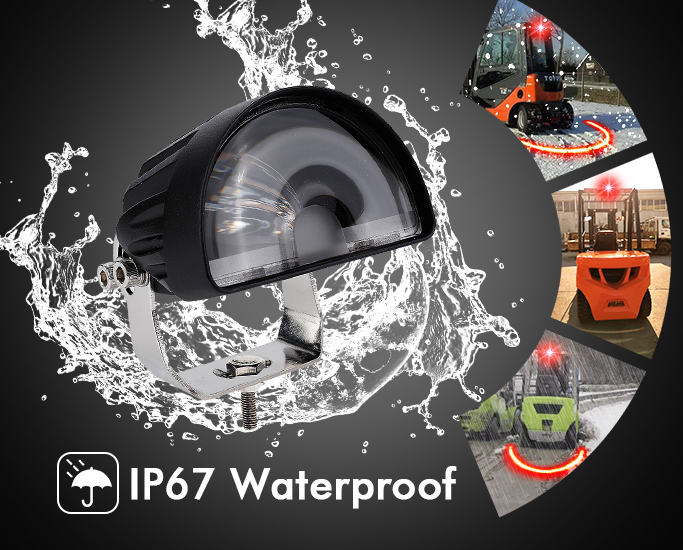
IP67 provides one higher level of protection than IP65 and is our most widely used waterproof rating. Specification breakdown: Complete dustproofing (IP6 level) remains unchanged, and the waterproof level is upgraded to “7,” which allows temporary immersion in 1-meter-deep water for 30 minutes. No water will enter the lamp during this time, and it can easily cope with daily heavy rain, water splashing, and other scenarios. The applicable scenarios are mainly rainy areas and outdoor areas with temporary water accumulation, such as outdoor loading docks in southern China during the rainy season, construction sites with temporary water accumulation, and open-air warehouses. Our IP67-level products—Forklift Safety Light, LED Work Light, Gobo Projector Light, etc.—have upgraded sealing structures, using double silicone seals and a waterproof aviation connector, which can resist rainwater and accumulated water immersion and cope with severe vibration during forklift operation and prevent sealing failure. It should be noted that IP67’s “temporary immersion” is intended only for accidental exposure, and the lamp must not be immersed in water for long periods; otherwise, the protection effect will be affected. For forklifts that often operate outdoors and face variable weather, IP67 is the preferred choice that balances protection and cost.
IP68 – Dust-Tight + Long-Term Immersion
IP68 is a high protection level among forklift LED lamps. Specification breakdown: Complete dustproofing (IP6 level), waterproof rating upgraded to 8, which allows long-term immersion in water deeper than 1 meter (specific depth and time defined by the manufacturer), can withstand sustained water pressure, and is suitable for extremely humid and waterlogged harsh working conditions. The applicable scenarios are mainly outdoor long-term waterlogged construction sites, docks (which may be submerged during high tide), forklifts near aquaculture facilities, and special operation forklifts that need frequent contact with water. To produce IP68-rated products, we use fully sealed potting technology, which can not only completely isolate water and dust but also resist erosion from impurities and oil in water, ensuring that the lamp works stably in long-term immersion or extremely humid environments without short circuits, LED chip damage, or other failures. It should be noted that the production cost of IP68 is relatively high, and there is no need to choose it blindly if long-term immersion is not required.
IP69 – Dust-Tight + High-Pressure & High-Temperature Wash
IP69 is an industrial-grade high protection level, featuring complete dustproofing (IP6 level) and resistance to high-pressure, high-temperature water flushing. It meets industrial cleaning standards, withstanding 80°C and 80–100 bar direct water jets, ideal for frequent high-pressure cleaning scenarios like food processing or heavy industrial workshops. Our only IP69 product is the Forklift Camera Monitor System, equipped with heat-resistant seals and a reinforced housing to ensure stability under harsh cleaning. It is unnecessary for ordinary forklift scenarios and avoids extra costs.
IPX4 – Splash-Proof (For LED Laser Lights)
Not all our products have a dustproof rating of 6; our LED Laser Lights use IPX4, which has no defined dust rating (only basic protection against large particles) but offers omnidirectional splash resistance. Designed for path guidance and area warning, it is ideal for low-dust, light-splash settings such as indoor warehouses. Our IPX4 laser light has a sealed design to resist splashes and basic dust but is not suitable for high-dust, heavy water spray, or waterlogged environments; additional dust protection is recommended for these uses.
Key Buying Tip: Match IP Rating to Your Working Scene
Many customers mistakenly believe the higher the IP rating, the better. This is not true.
• Using IP69 in a dry indoor warehouse is unnecessary and wastes cost.
• Using IP62 or IPX4 outdoors leads to water damage, higher maintenance costs, and safety risks.
The right strategy is scene-based selection: choose the IP rating that matches your environment to ensure safety, reliability, and optimal cost-effectiveness.
As a professional manufacturer of forklift safety lighting and monitoring systems, we test every product to perform reliably in its intended environment. We never recommend over-specifying or under-specifying your lighting.
Get a Custom IP Rating Recommendation
If you are still unsure which IP level of LED forklift warning lights is suitable for your forklift operation scenario or have a selection demand for Forklift Camera Monitor System, you can contact us anytime. Based on your specific operating environment (indoor/outdoor, whether there is water accumulation, whether high-pressure cleaning is needed, etc.), we will recommend the most suitable forklift LED lamps and monitoring system solutions for you.




 Network Supported